
Cyber OSINT can look very technical from the outside. It is easy to focus on the domains, IP addresses, usernames, malware indicators, aliases, and infrastructure. Those pieces matter, of course, but they are only part of the work. A big part of OSINT is knowing how to research carefully, verify what you are seeing, and connect small details without trying to force a conclusion.
Investigative research offers a useful perspective for cyber OSINT. In background investigations and public-record research, the first result is not always the full story. A name, address, court record, or public-record result may be useful, but it still has to be checked against other information and placed in context. One record can point an investigation in the right direction, but it can also create confusion if it is not verified carefully.
The same principle applies to cyber OSINT. Whether the starting point is a court record, a username, a domain, or an email address, the process is not just “find something and report it.” The real work is figuring out what the information means, how reliable it is, and whether it actually connects to the question being investigated.
Starting With One Small Breadcrumb
A lot of investigations start with something small. In a traditional investigation, it could be a name, address, phone number, alias, court record, or employment history. In cyber intelligence, it might be a domain, IP address, email address, file hash, online handle, or social media profile.
By itself, that first clue may not prove much. A username might be common. A domain might be newly registered but not necessarily malicious. An email address might show up in a breach database but still need more context. The value comes from treating that first piece of information as a lead instead of an answer.
For example, a suspicious-looking domain might lead an analyst to look at WHOIS information, certificate transparency records, passive DNS, urlscan.io results, or related infrastructure. The domain might connect to an email address, a hosting provider, a redirect chain, or another domain using a similar naming pattern. None of those things automatically prove intent, but they can help build context.
That part feels very similar to investigative research outside of cyber. A name alone is rarely enough. You may need to compare dates, addresses, locations, aliases, or record details before deciding whether something belongs to the right person or the right situation. The same mindset applies in cyber OSINT, just with different types of identifiers.
Why Verification Matters
One of the easiest mistakes in OSINT is believing something because it appears online. Public information can be outdated, copied from somewhere else, incomplete, or connected to the wrong person. Cyber data has similar issues. An IP address may be shared by many users. A domain may have been compromised rather than created for malicious activity. A username may be used by more than one person across different platforms.
That is why verification matters so much. Investigative research requires caution with information that looks useful but has not been checked. It is tempting to see a match and immediately want to connect it, especially when the pieces seem to line up. But similar does not always mean connected.
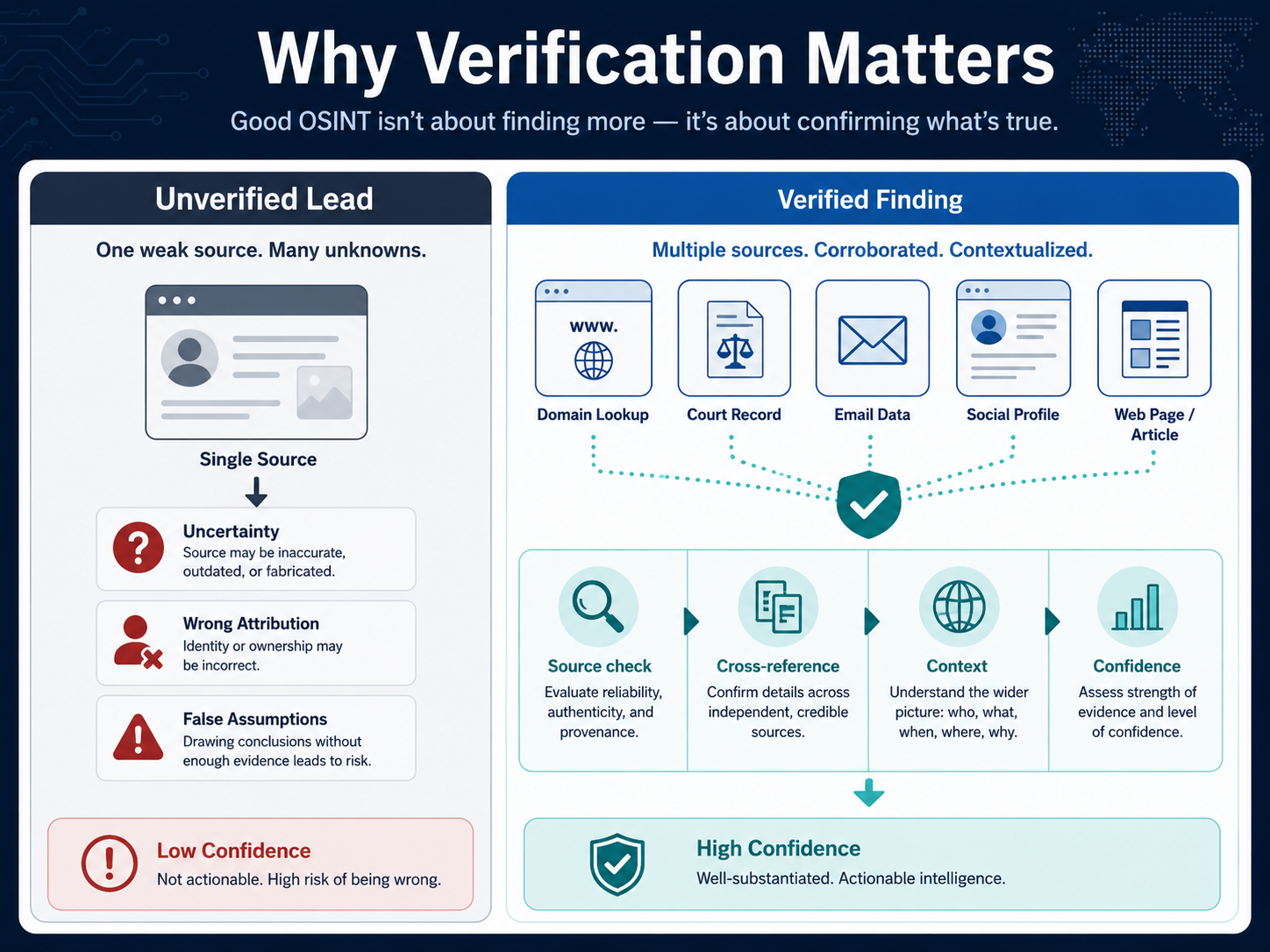
In cyber OSINT, this can make a big difference. If an analyst assumes too much from a single indicator, it can send the investigation in the wrong direction. On the other hand, if the analyst takes time to compare sources and look for supporting information, the final assessment is usually much stronger.
Good OSINT is not only about finding information quickly. It is about knowing what can be trusted, what needs more context, and what should be treated carefully.
Connecting Information Without Forcing It
Cyber OSINT often involves information that looks scattered at first. A domain may connect to an email address. The email address may connect to a username. The username may appear on a forum, social media platform, paste site, or other public source. A post may mention a tool, service, location, target, or piece of infrastructure.
Sometimes those connections matter. Sometimes they do not. That is where the analyst has to be careful.
This is one of the areas where investigative thinking is especially useful. In background or public-record research, analysts often have to decide whether two pieces of information actually belong together. Just because two records have the same name does not mean they refer to the same person. Just because two pieces of cyber data appear near each other does not mean they are part of the same activity.
That kind of judgment is important because OSINT can produce a lot of information very quickly. The challenge is not always finding more. Sometimes the challenge is knowing what to leave out, what to flag as uncertain, and what deserves more research.
Source Reliability Is Part of the Work
Not all sources should be treated the same. An official record or direct technical observation may carry more weight than a copied post, an automated scan result, or a third-party claim. That does not mean less direct sources are useless. It just means they should be handled with the right level of caution.
When reviewing information, analysts should consider where it came from and how much confidence can reasonably be placed in it. Is it current? Is it from the original source? Can it be confirmed somewhere else? Is it something directly observed, or is it an assumption based on surrounding details?
Those questions matter because intelligence work depends on accuracy. It is better to say that something needs more verification than to overstate what the information shows. That does not make the research weaker. It makes it more honest.
Documentation Makes the Work Useful
An investigation is only helpful if someone else can understand how the conclusion was reached. Good documentation gives another analyst, supervisor, or decision-maker a way to follow the logic behind the findings.
For OSINT work, documentation does not have to be overly complicated, but it does need to be clear. It should show the original lead, the sources reviewed, the relevant findings, confidence level, timestamps, and any limits or gaps. It should also make clear when something is confirmed versus when something is only possible.
This is something that translates directly from investigative research. If the reasoning is not documented, it is harder to review, validate, or build on later. A strong finding should not only answer “what did you find?” It should also make it clear how you got there.
Being Careful With Assumptions
One habit that matters in both traditional investigations and cyber OSINT is separating facts from assumptions. That sounds simple, but it can be difficult when several pieces of information seem to point in the same direction.
Finding the same username on two platforms does not automatically prove the same person controls both accounts. Seeing a domain hosted near suspicious infrastructure does not automatically mean every connected domain is malicious. Finding a public record near a location does not automatically connect someone to online activity from that area.
This is where wording matters. A careful analyst does not need to make the evidence sound stronger than it is. Sometimes the best wording is simply that something appears related, needs more review, or cannot be confirmed based on the information available. That kind of caution keeps the analysis honest.
Why Investigative Research Belongs in Cyber OSINT
Cyber intelligence is technical, and technical skills are important. Tools can help collect data, scan infrastructure, search public sources, and identify possible leads. But tools do not replace the analyst’s judgment.
Investigative research adds structure to the process. It helps analysts slow down, compare sources, notice inconsistencies, and explain findings clearly. It also helps prevent the mistake of collecting a lot of information without understanding what it actually means.
Cyber OSINT is not just about collecting indicators. It is about understanding relationships, context, and meaning. The most useful findings often come from patience, curiosity, and the willingness to follow the trail one step at a time.
Conclusion
Investigative research does not replace technical cyber skills, but it can make them stronger. A technical tool may surface the lead, but the analyst still has to verify it, understand it, and explain why it matters.
Whether the starting point is a public record, a username, a domain, or a threat indicator, the foundation is similar: ask good questions, check the details, document the path, and be honest about what the evidence shows. That is what makes investigative thinking such a valuable part of cyber OSINT.