
Introduction
Cyber Threat Intelligence (CTI) provides context about adversaries, their tactics, techniques, and procedures (TTPs), and indicators of compromise (IOCs). While CTI helps organizations prepare for threats, it cannot confirm that an attack actually occurred within a specific environment. Digital forensics bridges that gap by collecting, preserving, and analyzing system artifacts to determine what actually happened.
Key Takeaway
- Threat intelligence tells investigators where to look
- Digital forensics determines what actually happened
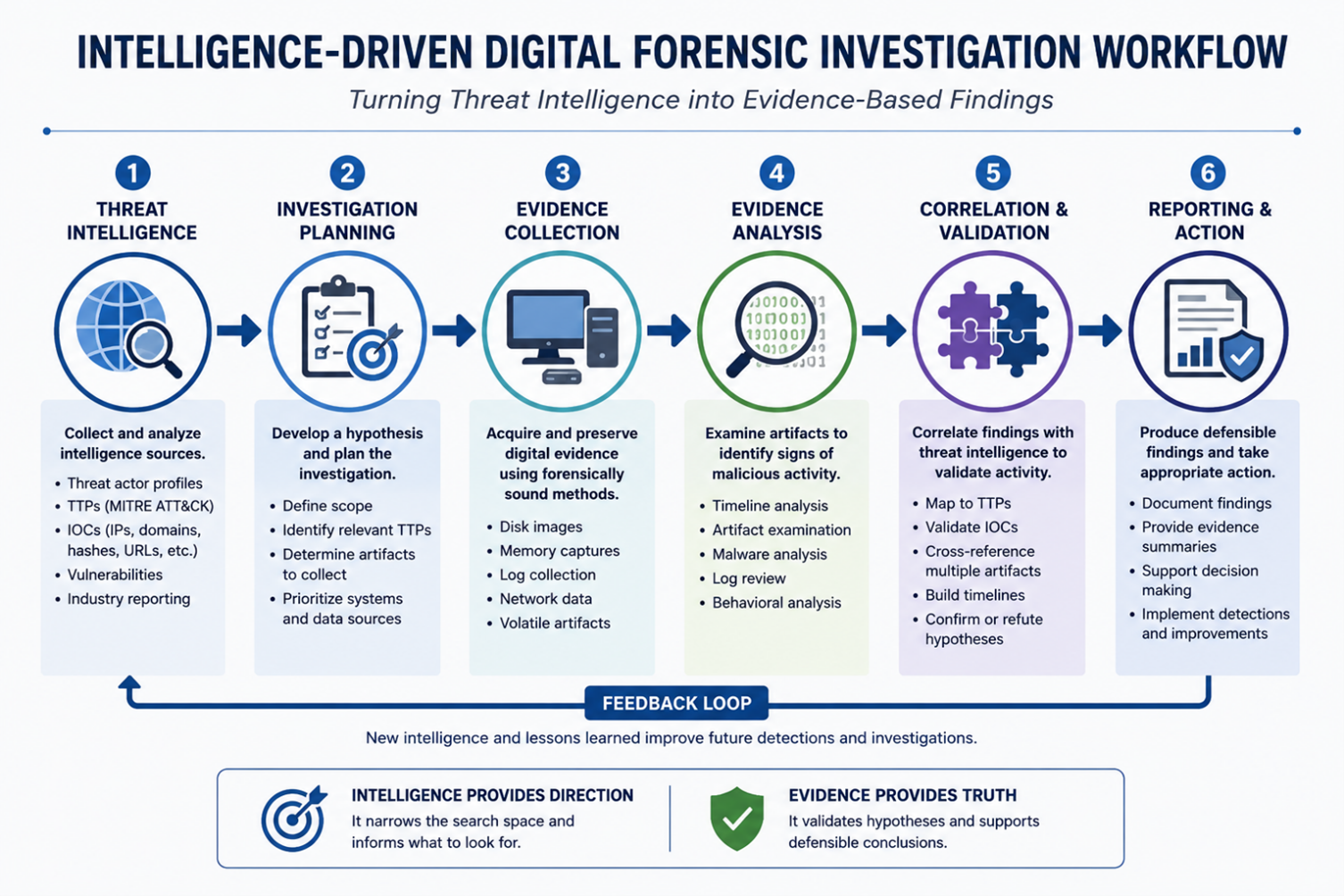
Threat intelligence provides investigative direction, while digital forensics validates findings through evidence.
Understanding Cyber Threat Intelligence
Threat intelligence transforms raw threat data into actionable information.
| Type | Purpose | Audience |
|---|---|---|
| Strategic | Long-term threats | Leadership |
| Operational | Campaigns | Incident Responders (IR) |
| Tactical | Tactics, Techniques, and Procedures (TTPs) | SOC / DFIR Teams |
| Technical | Indicators of Compromise (IOCs) | Detection Engineers |
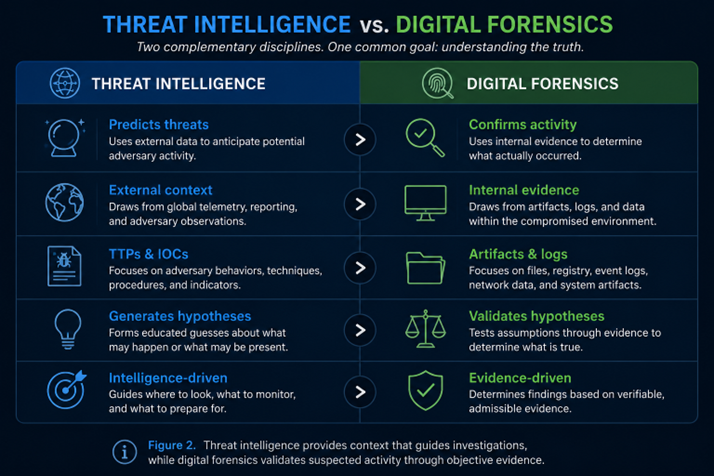
Threat intelligence provides context, while forensic artifacts provide objective evidence.
From Intelligence to Investigation
- Review the threat intelligence.
- Identify adversary TTPs.
- Map TTPs to MITRE ATT&CK.
- Identify forensic artifacts.
- Collect evidence.
- Correlate findings and validate conclusions.
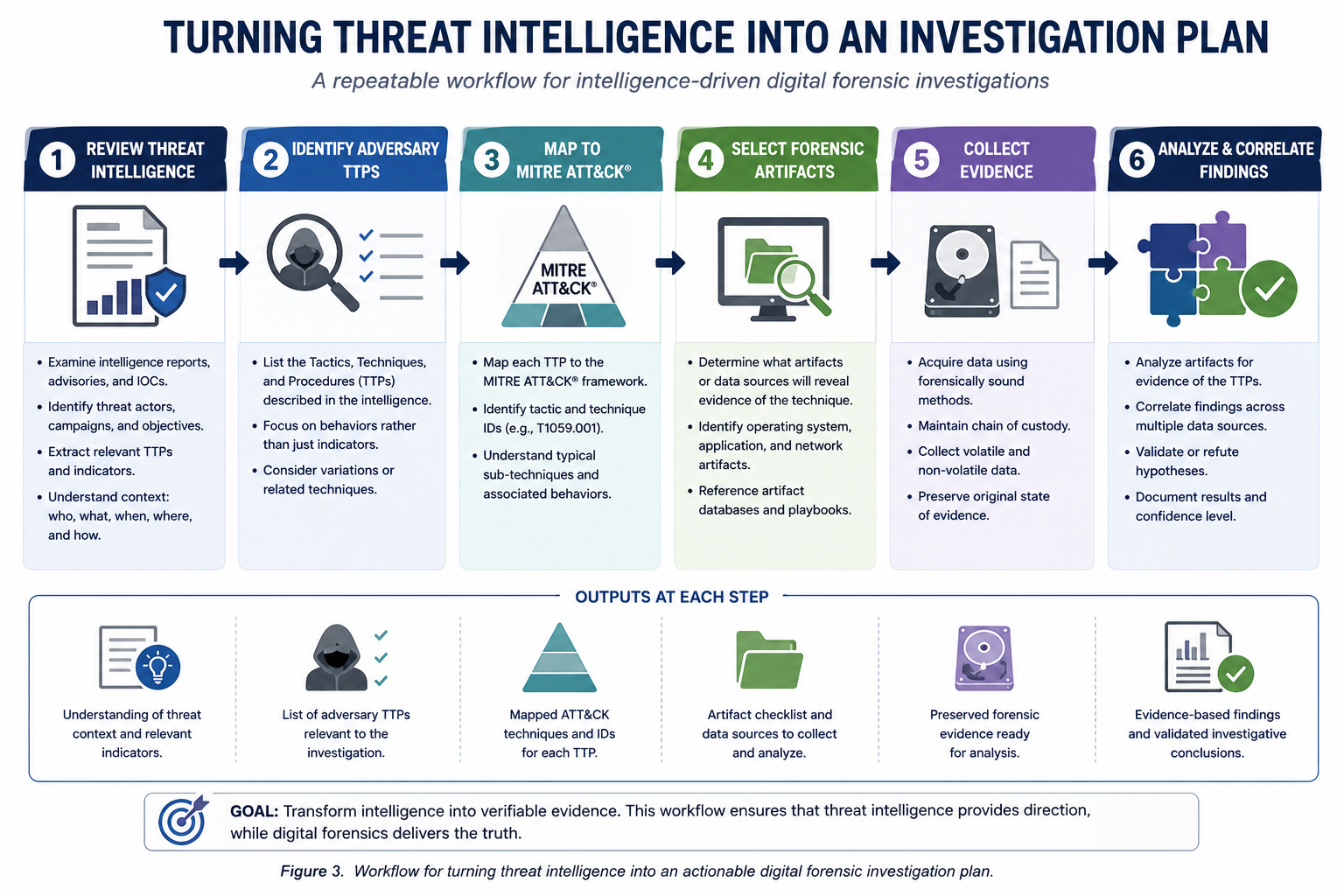
A repeatable workflow for transforming CTI into evidence-based investigations.
Mapping Threat Intelligence to Windows Artifacts
| Technique | Artifacts |
|---|---|
| PowerShell | PowerShell Logs, Event ID 4104 |
| Scheduled Tasks | Task Scheduler |
| Registry Persistence | Run Keys |
| Program Execution | Prefetch, AmCache |
| Lateral Movement | RDP/Firewall Logs |
Best Practices
- Treat CTI as context, not proof.
- Correlate multiple artifacts.
- Avoid confirmation bias.
- Document investigative reasoning.
Conclusion
Threat intelligence accelerates investigations, while digital forensics validates activity through objective evidence. Combining both disciplines enables accurate, evidence-based conclusions.